
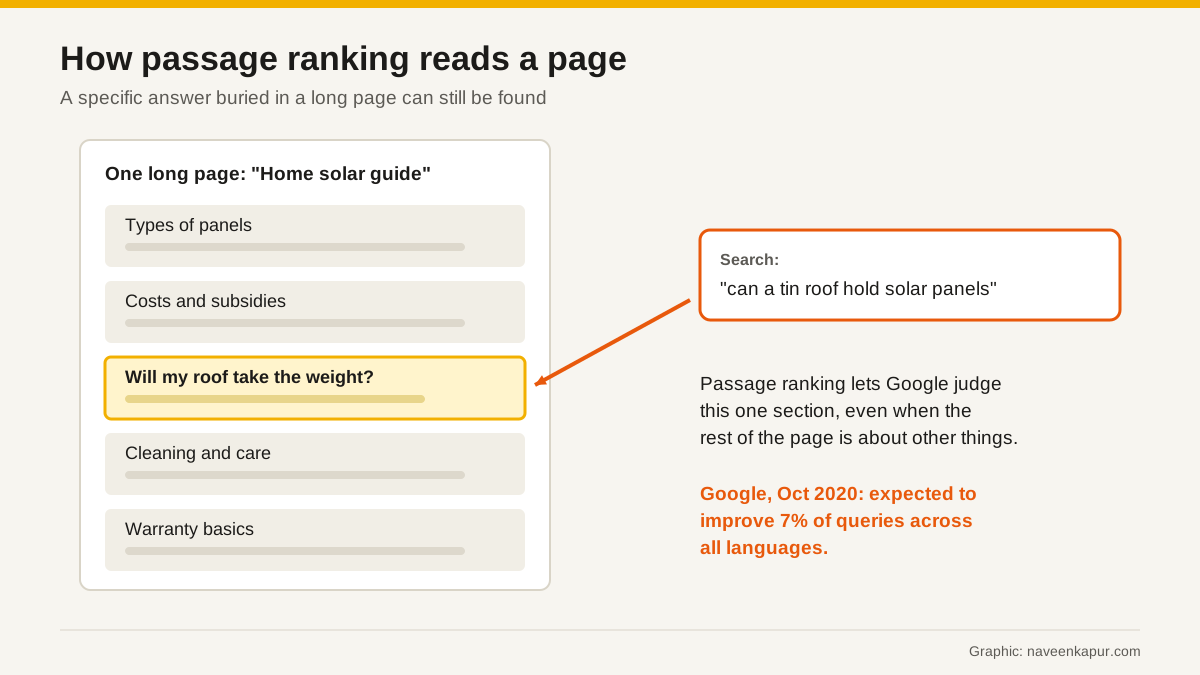
Picture a long guide called “Everything about home solar in India”. Somewhere in the middle, one paragraph answers a very specific question: can a tin roof take the weight of solar panels? Before 2020, that page might not rank for that question, because the page as a whole is about solar in general.
On 15 October 2020, at its Search On event, Google said it had “recently made a breakthrough in ranking”. It could now better understand the relevance of specific passages, not just whole pages. This is passage ranking.
What Google said
In the post “How AI is powering a more helpful Google”, Google explained the problem: very specific searches can be the hardest to get right, because sometimes the single sentence that answers your question might be buried deep in a web page. By understanding passages in addition to the relevance of the overall page, Google said it could find that “needle-in-a-haystack” information.
Google said the technology would improve 7 percent of search queries across all languages as it rolled out globally. Its example showed a featured snippet, but Google was clear that the improvement applies to how it ranks web pages overall, not only snippets.
Other changes announced the same day
Passage ranking was one of several AI changes at Search On 2020. Knowing the others helps put it in context:
| Change | What Google said |
|---|---|
| BERT | Now used in almost every query in English |
| Spelling | A new spelling algorithm using a deep neural net. One in 10 queries every day is misspelled |
| Passages | Better understanding of specific passages; to improve 7% of queries across all languages |
| Subtopics | Neural nets to understand subtopics, for a wider range of results on broad searches, starting by the end of 2020 |
What passage ranking is, and what it is not
Google's current ranking systems guide describes it in one line: passage ranking is an AI system used to identify individual sections or “passages” of a web page to better understand how relevant a page is to a search.
- It is a ranking system. Some sites called it “passage indexing”. Google's own name for it is passage ranking, and it describes it as helping to judge the relevance of a page.
- It is not a reason to write very long pages. It helps when a long page already exists and has a good answer inside it. It does not reward length for its own sake.
- It is not something you switch on. There is no tag or markup for passage ranking. It works on the content Google already reads.

How to write long pages that work with passage ranking
- 1Use real questions as headings. “Will my roof take the weight?” is easier to match than “Structural notes”.
- 2Answer in the first one or two sentences under each heading. Then add the detail, examples and exceptions.
- 3Keep one idea per section. If a section answers three questions, split it into three.
- 4Use the words your customers use. Think “EMI”, “subsidy”, “society permission”, not only technical terms.
- 5Add tables and lists for comparisons and steps. They make a passage easy to understand on its own.
- 6Decide when a topic deserves its own page. If a sub-question gets real search demand and needs a long answer, a separate page may serve it better, linked from the main guide.
A before and after example
Before: a section headed “Installation” with 400 words that mix roof types, permissions from the housing society, wiring and costs in one long block.
After: the same content split into four short sections: “Can a tin roof take solar panels?”, “Do I need housing society permission?”, “How long does installation take?” and “What does installation cost?”. Each starts with a direct one-line answer, followed by the detail.
Nothing new was written, but each answer now stands on its own. A reader scanning the page finds it faster, and so can Google's systems when someone searches for that exact question.
How it fits with later Google changes
Passage ranking was a step on the same road as BERT before it and MUM, SGE and AI Overviews after it: understanding the specific need behind a search and finding the exact part of the web that answers it. AI features such as AI Overviews also pick out sections that answer parts of a question. Pages built from clear, self-contained sections are well placed for all of them.
Quick check for your existing long pages
- Can a reader scan the headings and find their answer in under ten seconds?
- Does each section's first sentence answer its heading directly?
- Are important answers in the text, not only inside images or PDFs?
- Is the page fast and easy to read on a phone? See our Core Web Vitals guide.
- Do internal links point readers to deeper pages for each big sub-topic?