On 10 May 2023 Google published a post called “Supercharging Search with generative AI”. It introduced an experiment called SGE, short for Search Generative Experience. For the first time, Google tested writing its own short answer at the top of the results page, using a large language model, with links to the web pages behind it.
SGE never became a normal part of Search under that name. It lived inside Search Labs, an opt-in area for early experiments, for about a year. Then, in May 2024, its AI summaries became AI Overviews, which millions of people now see without signing up for anything. This article tells the SGE story, because most of what SEOs know about AI search today was learned during that year.
What SGE looked like
Google's launch post used a family travel question as its example: which is better for a family with kids under 3 and a dog, Bryce Canyon or Arches. Normally you would break that into several searches and piece the answer together yourself. With SGE, Google showed an AI-powered snapshot of the key points, with links to dig deeper.
Below the snapshot sat suggested next steps and the option to ask a follow-up question. Tapping one opened a conversational mode, where Google carried context from one question to the next. Google also said it would limit the types of queries where these answers appeared, and that you could expand the view to see how a response was corroborated by web pages.
Shopping searches got their own version. Google said the AI shopping snapshot was built on its Shopping Graph, which at the time had more than 35 billion product listings, with more than 1.8 billion refreshed every hour.
SGE timeline
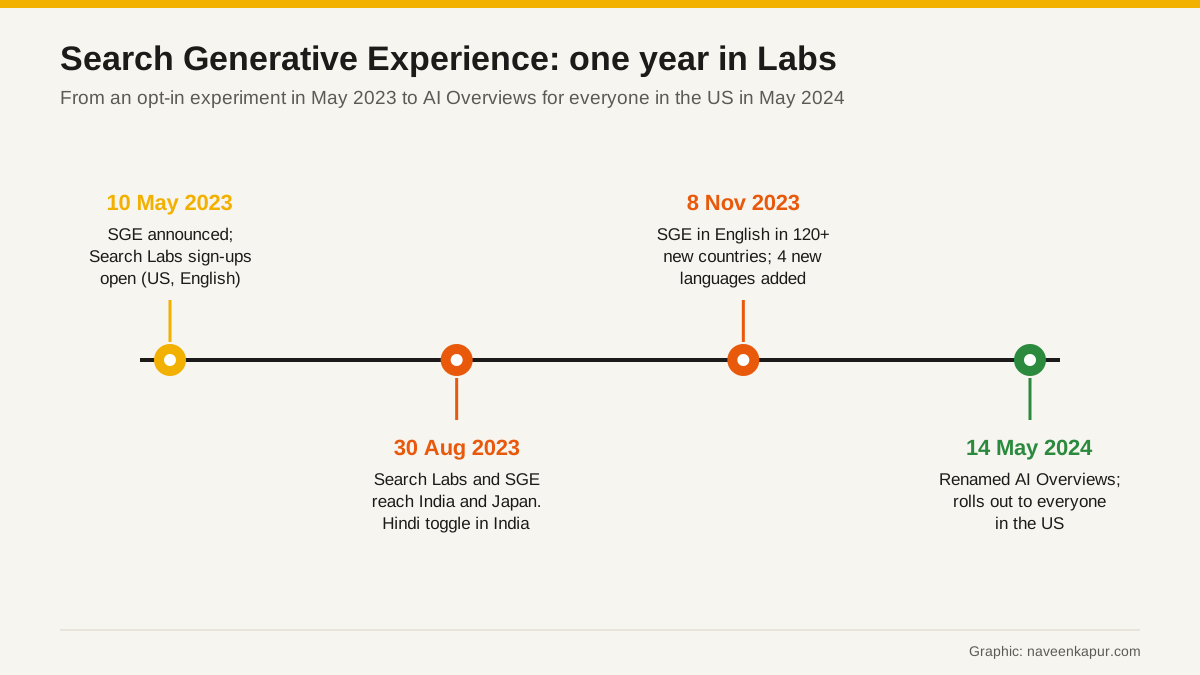
| Date | What happened |
|---|---|
| 10 May 2023 | SGE announced as a Search Labs experiment on Chrome desktop and the Google app, US only, English only. Labs sign-ups opened the same day, with access “in the coming weeks” |
| 15 Aug 2023 | Google said SGE had launched “less than three months ago” and added definitions on hover, coding help and “SGE while browsing” |
| 30 Aug 2023 | Search Labs and SGE launched in India and Japan, the first countries outside the US |
| 8 Nov 2023 | SGE in English opened to more than 120 new countries and territories, plus Spanish, Portuguese, Korean and Indonesian |
| 14 May 2024 | AI Overviews begin rolling out to everyone in the US. Google said people had already used AI Overviews “billions of times” in Search Labs |
What SGE meant for India
India was one of the first two countries outside the US to get SGE. Google's post said Indian users could use it by typing or by voice, and that India had something unique: a language toggle to switch between English and Hindi. Indian users could also listen to the responses, which Google called a popular preference. Search ads continued to appear in their own ad slots.
For Indian businesses this was the first real sign that AI answers would matter in local languages too, not just in English. A Hindi query and an English query could now lead to the same AI summary, drawn from pages in either language.
What Google said about links and websites
From day one Google said SGE was designed to “highlight and drive attention to content on the web” and that it was committed to sending valuable traffic to sites. In August 2023 it made the source web pages easier to find inside the AI overviews. In November 2023 it said SGE was showing more links, and links to a wider range of sources, on the results page.
When SGE became AI Overviews in May 2024, Google said the links included in AI Overviews get more clicks than if the page had appeared as a traditional web listing for that query. That is Google's claim, not an independent measurement, but it shows how Google wanted the feature to be seen: as a new way into websites, not a replacement for them.
Lessons SEOs learned during the SGE year
- 1Complex questions get one answer. SGE was built for questions people used to split into several searches. Pages that answer one part of such a question clearly and specifically have a chance to be one of the sources.
- 2Simple facts need a reason to click. If a snapshot can state the fact, the page needs depth: prices, tools, examples, local detail, photos or first-hand experience.
- 3Trust matters more. When only a few links appear next to an answer, reliable pages with clear authors and accurate facts stand out. This is the same thinking as E-E-A-T.
- 4Snippet controls still apply. The usual nosnippet and max-snippet controls decide what Google may show from a page. Blocking snippets also limits how a page can be used in AI features.
- 5Measure by page. Total traffic hides change. Watching Search Console clicks and impressions for each important page shows which ones gain or lose as AI features grow.
SGE, AI Overviews and AI Mode: how they relate
| Name | When | What it is |
|---|---|---|
| SGE | May 2023 to May 2024 | Opt-in Labs experiment with AI snapshots and a conversational mode |
| AI Overviews | From 14 May 2024 | AI summary inside normal Google results, no sign-up needed |
| AI Mode | From March 2025 | A separate AI search tab built for long, multi-part questions |
The thread running through all three is the same. Google tries to answer the whole question, then points to the web pages that helped. You can read the next chapters in our guides to AI Overviews and Google AI Mode.
What to do today
SGE itself is history, but its lessons are current. Check that your key pages are indexed and allowed to show snippets. Make each section answer one clear question in its first two sentences. Add what only you can add: your own data, photos, process and local knowledge. And keep the technical basics strong, from Core Web Vitals to mobile-friendly pages.