On 25 October 2019 Google announced what it called one of the biggest leaps forward in the history of Search. The change had a short name, BERT, and a simple aim: understand what people mean, not just which words they type.
Before BERT, Google was very good at matching keywords. It was much weaker at the small words that change the meaning of a sentence. Words like “to”, “for”, “no” and “without” were often treated as noise. BERT fixed that.
What BERT actually is
BERT stands for Bidirectional Encoder Representations from Transformers. Google's research team published it and made it open source in November 2018, a year before it reached Search.
- Bidirectional
- It reads each word together with the words on both sides of it, left and right, at the same time.
- Transformers
- The type of neural network it uses. It looks at how every word in a sentence relates to every other word.
- Pre-trained
- It learned language by reading huge amounts of text first, then was tuned for search tasks.
Older systems read a search more or less word by word. BERT reads the whole thing at once. That is why it understands that “to” in “brazil traveler to usa” says which way the person is travelling.
Google's own before-and-after example
Google explained the change with a real search: “2019 brazil traveler to usa need a visa”. The person is a Brazilian who wants to visit the United States.
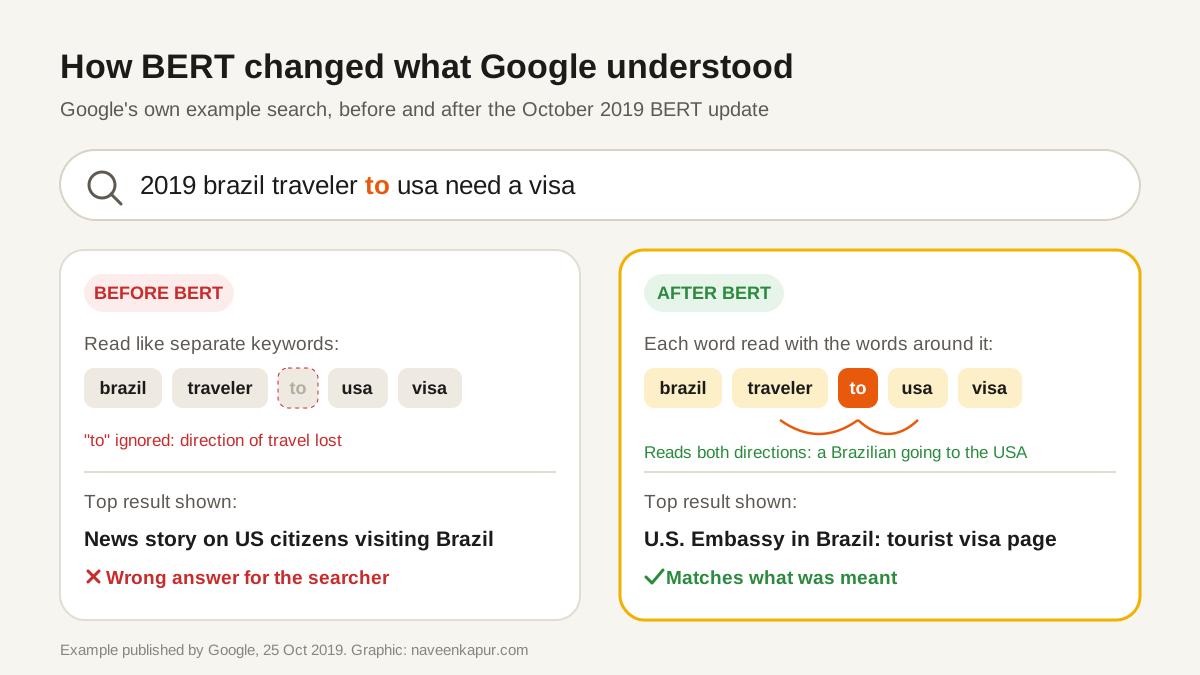
Before BERT, Google missed the importance of “to” and showed a news story about US citizens travelling to Brazil, the opposite of what was asked. After BERT, the top result was the U.S. Embassy in Brazil's tourist visa page.
Google shared more examples in the same announcement:
- “do estheticians stand a lot at work”: older systems matched “stand” with “stand-alone”. BERT understood it meant physically standing during the job.
- “can you get medicine for someone pharmacy”: BERT understood the question is about collecting a prescription for another person.
- “parking on a hill with no curb”: older systems gave too much weight to “curb” and ignored “no”. BERT kept the “no”.
How big the change was
| Date | What happened |
|---|---|
| Nov 2018 | Google Research open-sources BERT |
| 25 Oct 2019 | BERT goes live in Search for English queries in the US, about 1 in 10 searches |
| 25 Oct 2019 | Also used for featured snippets in two dozen countries |
| 9 Dec 2019 | Expanded to more than 70 languages |
| Oct 2020 | Google says BERT is used on almost every English query |
One in ten searches sounds small. It is not. Google handles billions of searches a day, and the ones BERT helped most were the hardest ones: longer, conversational questions where the meaning hangs on one small word.
What BERT changed for SEO
Many site owners asked how to “optimise for BERT”. Google's answer, from its Search Liaison Danny Sullivan, was direct: there is nothing to optimise for. BERT does not reward a technical trick. It rewards a page that clearly answers the question the person really asked.
In practice, three things shifted:
- 1Exact-match keyword phrases lost value. Writing “best hotel Delhi cheap” in a sentence to match a search had always read badly. After BERT, Google understood the plain sentence “an affordable hotel in Delhi” just as well.
- 2Specific answers won. A page that answers “can I renew a passport without the old one” directly beats a general passport page that only mentions the words.
- 3Long-tail searches became easier to win. Small sites that answered narrow questions well got a fairer chance against big sites that only matched keywords.
What BERT did not change
- It was not a penalty. Sites did not “get hit by BERT” for doing something wrong.
- It did not replace Google's other ranking systems. Links, page quality and relevance still mattered.
- It did not make keywords useless. People still search with words, and your page still needs to use the words your readers use.
BERT was the start of a longer road. Google later added MUM (2021) and, in 2024, AI Overviews built on its Gemini models. Each step pushed in the same direction BERT set: understand the question, then find the page that answers it best. That is also why Google's core updates keep rewarding helpful, people-first content.
A simple checklist
- Every important page answers one clear question or job.
- Headings are written as the questions customers ask.
- The answer comes first, the detail after.
- No stuffed or awkward keyword phrases.
- Small words that change meaning (for, to, without, near, under) are used naturally, because readers use them.