
Most business owners hire an SEO consultant once or twice in their life, so they have little to compare against. Meanwhile their inbox is full of offers: “Page 1 in 30 days”, “1,000 backlinks for ₹5,000”, “Guaranteed top 3 rankings”. It is hard to know who to trust.
Google itself has a page for exactly this situation, called “Do you need an SEO?”. It lists questions to ask and warning signs to look for. The 12 questions below build on that page, with what a good answer sounds like.
First: what an SEO consultant should do
Google describes useful SEO work as things like reviewing your site's content and structure, technical advice on hosting, redirects and error pages, content development, keyword research, and training your team. In short: making your site easier for Google to understand and more useful for the people searching. It is not a trick, and it does not happen in a week.
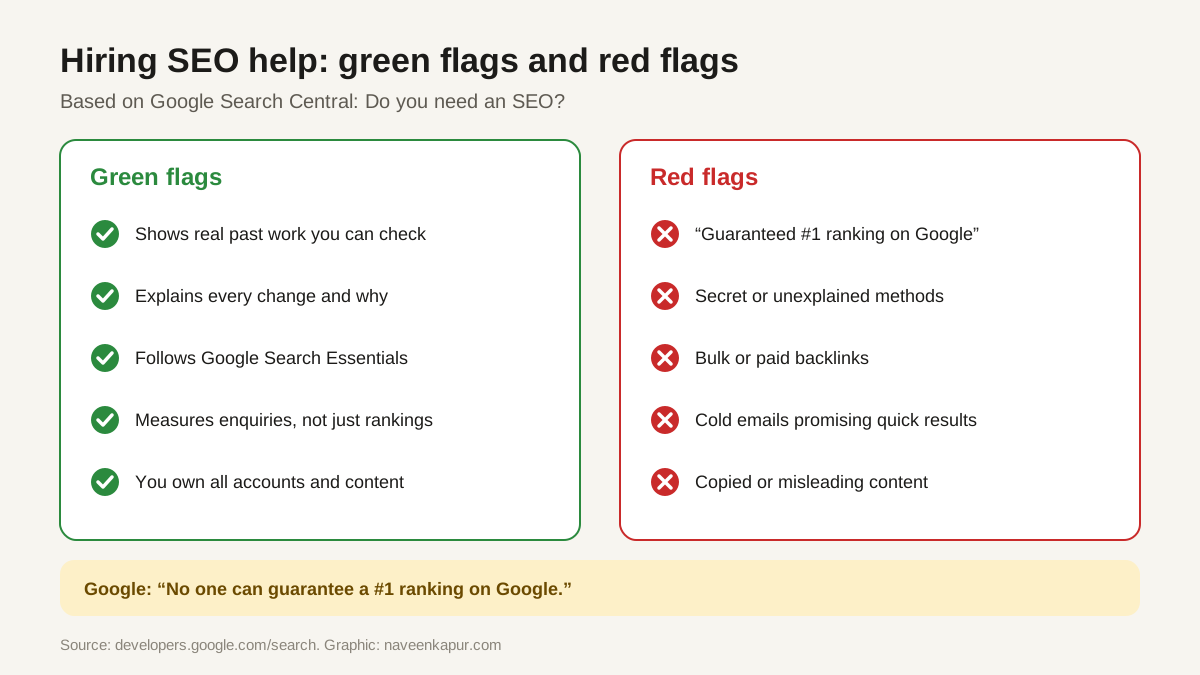
The 12 questions
1. Can you show me examples of your previous work?
This is Google's first suggested question. Ask for websites you can look at yourself, what the problem was, what they changed, and what happened. Be wary of results you cannot verify, or of names they cannot share at all.
2. What results do you expect, in what timeframe, and how will you measure them?
Also from Google's list. A good answer talks about enquiries, calls, sales or qualified traffic, not only rankings. It gives a realistic timeline with milestones, and says what is outside their control.
3. Do you follow Google Search Essentials?
Search Essentials (formerly the Webmaster Guidelines) are Google's rules. Anyone working on your site should know them and the spam policies well. Ask them to name a few things those policies prohibit.
4. What is your experience in my industry and my city?
A consultant who knows education, healthcare or hospitality knows how customers search in that field. For a local business, ask how they handle Google Business Profile and local search.
5. Will you tell me every change you make to my site, and why?
Google suggests asking this directly. You should get a written record of changes and the reason for each. If something breaks later, you need to know what was touched.
6. What will you do in the first 30 days?
A clear answer usually starts with an audit: indexing, technical issues, content and competitors. See our SEO audit checklist for what that should cover.
7. How do you get links?
Google warns against SEOs who talk about link popularity schemes or submitting your site to thousands of search engines. Good answers mention earning links with useful content, real partnerships, PR and local listings. Bad answers mention buying links, private blog networks or bulk directory submissions.
8. How will you handle content?
Ask who writes it, who checks the facts, and how your own knowledge gets into it. Content made mainly to rank, without real experience, is exactly what Google's helpful content work targets.
9. What access do you need, and who owns the accounts?
You should own your domain, hosting, Search Console, Analytics and any content they create. Give them user access, not ownership. If you part ways, you keep everything.
10. How will we communicate, and what reports will I get?
Agree how often you meet, who your contact is, and what a monthly report contains. A good report explains what was done, what changed and what is next, in plain language.
11. Do you also offer, or work with, other marketing like Google Ads?
SEO works better when it is connected to ads, Google Analytics 4 tracking and your sales process, so you can see which searches turn into customers.
12. How long have you been doing this, and what happened during big Google updates?
Someone who has worked through several core updates can tell you what they learned when rankings moved. Listen for honesty about losses as well as wins.

Red flags Google warns about
| Red flag | Why it matters |
|---|---|
| “Guaranteed #1 ranking” | Google says no one can guarantee a #1 ranking on Google |
| Cold emails promising quick results | Google says to be wary of SEOs who email you out of the blue |
| Secret or unexplained methods | Google says to be careful if a company is secretive or will not explain what it will do |
| Link schemes or “submission to 1,000 search engines” | These break Google's spam policies and can harm your site |
| Misleading or copied content | Google warns this can get a site removed from its index |
Consultant, freelancer or agency?
| Option | Usually good for | Watch out for |
|---|---|---|
| Independent consultant | Strategy, audits and senior attention | Limited hands for large amounts of content |
| Freelancer | Specific tasks with a clear brief | You may need to manage the strategy yourself |
| Agency | Large sites needing many skills at once | Your account handled by junior staff |
Whoever you choose, the right fit is someone who understands your business, explains their work in plain words, and measures success the way you do: in enquiries and customers.